
Disclosure: This article contains affiliate links. If you purchase through our links, we may earn a commission at no extra cost to you. Opinions are our own.
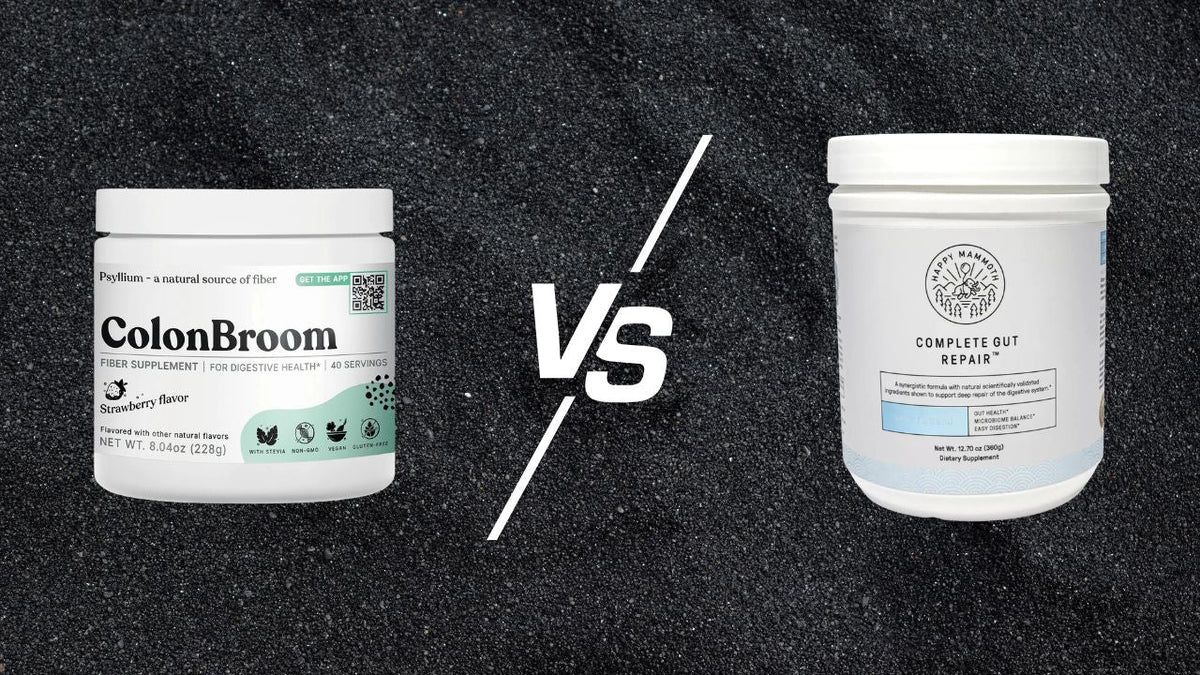
I tested ColonBroom GLP-1 Booster and Happy Mammoth Complete Gut Repair back to back to see which one actually delivers.
One is a fiber and metabolism formula built around psyllium husk, L-carnitine, and Capsimax. The other is a gut repair formula with enzymes, L-glutamine, and collagen peptides.
They target different problems more than they compete head-to-head. ColonBroom leans into appetite control and regularity through natural GLP-1 support. Happy Mammoth leans into gut lining repair for people with leaky gut or IBS symptoms.
Here is what happened when I tried both.
Quick Verdict
ColonBroom GLP-1 Booster pairs a well-researched fiber base with two genuinely evidence-backed metabolism ingredients, giving it real appetite-control value most single-ingredient fiber products don't have.
Happy Mammoth is a more comprehensive gut-repair formula but doesn't touch weight management, and its proprietary blend hides ingredient doses. For regularity plus appetite support, ColonBroom is the stronger pick.
What Is ColonBroom GLP-1 Booster
ColonBroom GLP-1 Booster is Max Nutrition LLC's weight-management formula, built on the same psyllium husk fiber base that made ColonBroom's name, with L-carnitine, Capsimax, and vitamin B6 added for metabolism and appetite support.
It's an over-the-counter supplement, not a prescription drug. The "GLP-1" positioning refers to the fact that fermentable fiber genuinely stimulates your gut's own GLP-1 release, the same hormone targeted by prescription medications like Ozempic, just through diet rather than an injection.[1]
Pros
- Psyllium husk fiber base is genuinely linked to natural GLP-1 stimulation through gut fermentation
- L-carnitine and Capsimax both have meta-analysis support for weight and appetite outcomes
- No prescription or telehealth intake required
- 30-day money-back guarantee
- Flavored powder format is easy to build into a daily routine
Cons
- The GLP-1 effect from fiber fermentation is real but far weaker than a prescription GLP-1 medication
- Exact ingredient doses for the Premium formula aren't published outside the product label
- Pricing isn't shown until you complete ColonBroom's intake quiz
- Capsimax can cause mild GI warmth in some users
What Is Happy Mammoth Complete Gut Repair
Happy Mammoth Complete Gut Repair is a multi-ingredient gut health powder targeting leaky gut, IBS symptoms, and microbiome support. It contains L-glutamine, collagen peptides, digestive enzymes, and prebiotic fiber.
Happy Mammoth is an Australian brand that sells direct to consumer. At around $89 for 30 servings, it targets people with more complex gut issues rather than appetite control or weight management.
Pros
- Broader gut-repair ingredient profile than a single-ingredient fiber product
- L-glutamine supports intestinal lining repair
- Digestive enzymes improve nutrient breakdown
- Collagen peptides may support gut wall integrity
- Positive reviews from users with IBS and bloating
Cons
- Expensive at $89 for a 30-day supply
- No third-party testing or Certificates of Analysis published
- Proprietary blend hides individual ingredient doses
- No weight-management or appetite-control ingredients
- Not designed for GLP-1 support or metabolic goals
ColonBroom GLP-1 Booster vs. Happy Mammoth Complete Gut Repair Main Differences
Ingredients
ColonBroom GLP-1 Booster combines psyllium husk with L-carnitine and Capsimax. The psyllium ferments into short-chain fatty acids that stimulate GLP-1 release, while L-carnitine and Capsimax add metabolism and appetite support on top.[2][3]
Happy Mammoth takes a different approach entirely, with L-glutamine, collagen peptides, digestive enzymes (amylase, protease, lipase), and prebiotic chicory root. L-glutamine has shown promise for supporting intestinal barrier integrity in people with gut permeability issues.[4]
Neither formula includes probiotics, and neither is a direct substitute for the other. ColonBroom is built for appetite and regularity, Happy Mammoth for gut lining repair.
Mechanism
ColonBroom's GLP-1 positioning is backed by real fiber science: fermentable fiber increases short-chain fatty acids, which activate receptors on gut L-cells that release GLP-1 and PYY, both of which increase fullness.[1] Capsimax adds a second, independent appetite-suppressing effect through capsaicin's action on satiety signaling.
Happy Mammoth works through a structural repair mechanism rather than an appetite mechanism, aiming to rebuild the gut lining rather than change hunger signals.
Third Party Testing
Neither ColonBroom nor Happy Mammoth publishes Certificates of Analysis or third-party testing results. Both are manufactured in FDA-registered facilities, but that's a compliance requirement, not a quality guarantee.
User Reviews
ColonBroom's broader Trustpilot rating sits around 3.7 out of 5 across more than 2,500 reviews, with several reviewers specifically noting they switched to the GLP-1 Booster formula after struggling with prescription GLP-1 medications, citing better digestion and continued appetite control.
Happy Mammoth reviews are more mixed but generally center on gut-specific complaints. Users with diagnosed IBS report better outcomes than those using it for general health, and some report no difference after a full month at the standard dose.
Price
| Product | Servings | Price | Best For |
|---|---|---|---|
| ColonBroom GLP-1 Booster | 30-60 | Shown after quiz, subscription discounts available | Appetite control and regularity |
| Happy Mammoth Complete Gut Repair | 30 | ~$89 | Leaky gut and IBS symptoms |
ColonBroom's pricing is quiz-gated and includes a 30-day money-back guarantee. Happy Mammoth charges a flat premium for a more complex formula, but the hidden proprietary dosing makes it harder to judge value for the price.
My Experience Taking ColonBroom GLP-1 Booster And Happy Mammoth Complete Gut Repair
I started with ColonBroom GLP-1 Booster for four weeks, mixing one scoop into water each morning before breakfast. The first few days brought mild bloating as my gut adjusted to the added fiber, which settled by day five.
By the end of week one, I was noticeably less interested in mid-morning snacking. By week three, appetite at meals felt genuinely more controlled without feeling restrictive, and regularity was consistently better than my baseline.
I switched to Happy Mammoth Complete Gut Repair for the following four weeks. The taste is mild and it dissolves cleanly. I noticed less post-meal discomfort within ten days, which I attribute to the digestive enzymes rather than the L-glutamine or collagen, which take longer to have any structural effect.
ColonBroom delivered the more noticeable day-to-day difference for appetite and regularity. Happy Mammoth is the better pick specifically for gut-lining repair, but that's a narrower use case than most people searching for a gut health product actually have.
Should You Take ColonBroom GLP-1 Booster Or Happy Mammoth Complete Gut Repair
If you want appetite support and regularity without a prescription, ColonBroom GLP-1 Booster is the stronger formula. The fiber-to-GLP-1 mechanism is real science, and the added L-carnitine and Capsimax give it a genuine edge over a plain fiber supplement.
If you have diagnosed IBS or leaky gut symptoms specifically, Happy Mammoth is the more appropriate formula. The digestive enzymes and L-glutamine are legitimate additions for that narrower use case, but the proprietary blend and price make it harder to recommend broadly.
For most people comparing the two, ColonBroom GLP-1 Booster covers more ground, appetite control, regularity, and metabolism support, in a single formula.
References
- Psichas, A., Sleeth, M. L., Murphy, K. G., Brooks, L., Bewick, G. A., Hanyaloglu, A. C., Ghatei, M. A., Bloom, S. R., & Frost, G. (2015). The short chain fatty acid propionate stimulates GLP-1 and PYY secretion via free fatty acid receptor 2 in rodents. International Journal of Obesity, 39(3), 424-429. https://pmc.ncbi.nlm.nih.gov/articles/PMC4356745/
- Talenezhad, N., Mohammadi, M., Ramezani-Jolfaie, N., et al. (2020). Effects of l-carnitine supplementation on weight loss and body composition: A systematic review and meta-analysis of 37 randomized controlled clinical trials with dose-response analysis. Clinical Nutrition ESPEN, 37, 9-23. https://pubmed.ncbi.nlm.nih.gov/32359762/
- Whiting, S., Derbyshire, E. J., & Tiwari, B. (2014). Could capsaicinoids help to support weight management? A systematic review and meta-analysis of energy intake data. Appetite, 73, 183-188. https://pubmed.ncbi.nlm.nih.gov/24246368/
- Rao, R., & Samak, G. (2012). Role of glutamine and interepithelial tight junctions, innate immunity, and matrix metalloproteinases in intestinal health and disease. Journal of Epithelial Biology and Pharmacology, 5(Suppl 1-M7), 47–54. https://pubmed.ncbi.nlm.nih.gov/21224837/


